
Tanks in WWII: Armored Warfare's Impact
History, World War II, Armored Warfare
Steel on the Battlefield: The Role of Tanks in World War II
Tanks reshaped how World War II was fought, becoming symbols of industrial power and modern warfare.
From Supporting Role to Center Stage
Tanks first appeared in World War I, but they were clumsy and unreliable. By World War II, they had evolved into faster, more powerful machines that could decide the outcome of entire campaigns. Instead of being used only to support infantry, tanks became the spearhead of offensive operations, breaking through enemy lines and exploiting weaknesses at speed.
Nations invested heavily in armored forces. Germany developed Panzer divisions, Britain fielded cruisers and infantry tanks, the Soviet Union mass‑produced the T‑34, and the United States deployed the versatile M4 Sherman. Each design reflected a different philosophy, but all shared the same goal: combine firepower, protection, and mobility in a single, decisive weapon system.
Blitzkrieg and the Power of Mobility
The early war years showed how transformative tanks could be when used in large, coordinated formations. German commanders combined tanks with mechanized infantry, artillery, and close air support in a doctrine known as Blitzkrieg, or “lightning war.” Rather than slowly grinding forward, armored units punched through weak points and raced deep into enemy territory, encircling entire armies before they could respond.
In Poland, France, and the early stages of the Soviet campaign, tanks were the sharp edge of this strategy. Their speed and shock effect created confusion, overwhelmed defensive lines, and forced opponents to rethink their entire approach to warfare. Even when individual tanks were not the most heavily armored or best armed, their coordinated use made them devastating.
Tanks in Different Theaters of War
The role of tanks varied across the many fronts of World War II. In the vast spaces of the Eastern Front, they fought in enormous armored battles over open plains, where mobility and numbers were crucial. The Battle of Kursk in 1943, often cited as the largest tank battle in history, demonstrated how central armored forces had become to both German and Soviet strategy.
In North Africa, tanks clashed across deserts, where long sight lines and supply challenges shaped tactics. British and Commonwealth forces faced the German Afrika Korps in swirling, fast‑moving engagements, with tanks constantly maneuvering for advantageous positions. In Western Europe after D‑Day, Allied tanks supported infantry in hedgerows, towns, and cities, where close‑quarters fighting demanded careful coordination and exposed tanks to hidden anti‑tank weapons.
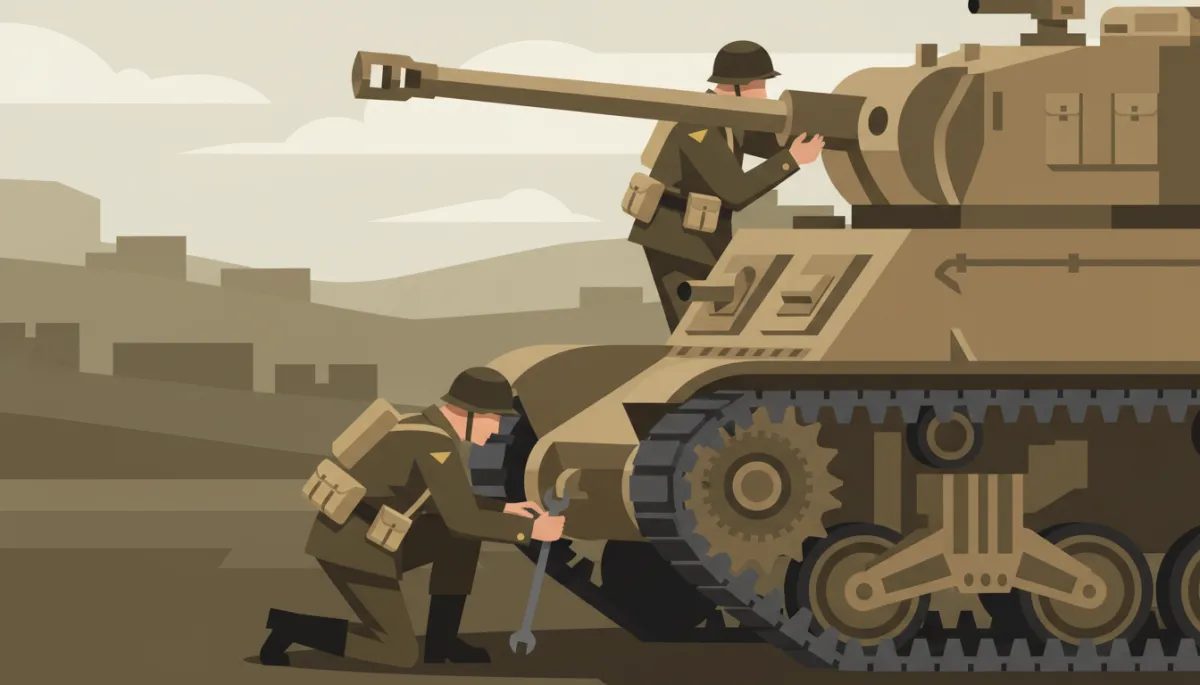
Behind every tank stood a trained crew whose teamwork made the machine truly effective.
Armored Duels, Infantry Support, and Urban Fighting
Tanks are often remembered for dramatic duels with enemy armor, and these encounters were certainly important. Heavily armed German Tigers and Panthers, for example, were feared opponents. However, much of a tank’s daily work involved supporting infantry: knocking out bunkers, suppressing machine‑gun nests, and providing a moving shield as soldiers advanced.
In cities and towns, tanks became both powerful assets and vulnerable targets. Streets, rubble, and tight corners limited their movement, while defenders used anti‑tank guns, mines, and handheld weapons to ambush them. This forced armies to refine combined‑arms tactics, pairing tanks closely with infantry, engineers, and artillery to cover one another’s weaknesses.
Technology, Production, and the Industrial War
The role of tanks in World War II cannot be separated from industry. Designing, building, and maintaining thousands of armored vehicles required vast factories, skilled workers, and steady supplies of steel, fuel, and spare parts. The war became a contest of production as much as battlefield skill. The United States and Soviet Union, in particular, used their industrial capacity to field huge numbers of reliable, if not always superior, tanks.
Technological innovation was constant. As armor grew thicker and guns more powerful, designers had to balance protection with mobility. Sloped armor, improved suspensions, better radios, and more efficient engines all shaped how tanks performed in combat. Meanwhile, opponents developed new anti‑tank weapons, creating a continuous cycle of adaptation on both sides.
Legacy: Tanks and the Future of Warfare
By the end of World War II, tanks had proven themselves indispensable. They were no longer experimental machines but core components of every major army. The conflict showed that armored forces, when combined with airpower, artillery, and infantry, could achieve breakthroughs that older methods could not. At the same time, the war highlighted their limits: tanks were vulnerable without support and could be defeated by determined defenders using the right tools and tactics.
The lessons learned from World War II shaped armored doctrine for decades. Modern main battle tanks, advanced as they are, still owe much to the designs and ideas tested between 1939 and 1945. Above all, the war demonstrated that tanks were more than machines of steel and firepower: they were instruments of strategy, symbols of national strength, and key players in one of history’s most destructive conflicts.

